
Temporary email is a double-edged sword. It excels at protecting your primary inbox from spam and phishing, but its very disposability creates significant risks. Using it for account logins, financial services, or important communications is unsafe due to a lack of encryption, no long-term access, and potential for data interception. Ultimately, its safety depends entirely on your use case—it’s a privacy tool for low-stakes interactions, not a secure replacement for a permanent email address.
Key Takeaways
- Temporary email is a privacy tool, not a security tool: Its primary function is to shield your main email from spam and data brokers, but it offers minimal protection against hackers or data interception.
- Never use temp mail for critical accounts: Banking, primary social media, work, or any account with recovery options tied to the email will be permanently lost when the temp address expires.
- Most temporary email services lack encryption: Emails are often stored and transmitted in plain text, making them readable by the service provider and anyone who intercepts the data.
- Anonymity can be a legal and ethical gray area: While legal for privacy, using temp mail to bypass bans, post abuse, or create fraudulent accounts violates most platforms’ Terms of Service and can have consequences.
- Reputable providers matter, but trust is still limited: Choose well-known services with clear privacy policies, but assume any email sent through a temp service could be logged or accessed by the provider.
- The biggest risk is human error: The convenience of a temp address can lead to complacency, causing users to forget which accounts are tied to it, resulting in irreversible loss of access.
- It’s perfectly safe for its intended purpose: Using a temp mail to download a PDF, get a one-time discount code, or sign up for a low-stakes forum is generally low-risk and achieves its goal of inbox protection.
📑 Table of Contents
- Introduction: The Allure and Anxiety of the Disposable Inbox
- How Temporary Email Services Actually Work
- The Privacy Benefits: Why You Might Want to Use Temp Mail
- The Security and Safety Risks: The Dark Side of Disposability
- Legal and Platform Policy Minefields
- Best Practices: How to Use Temporary Email Safely (If You Must)
- Conclusion: A Tool of Context, Not a Universal Solution
Introduction: The Allure and Anxiety of the Disposable Inbox
You’re excited to download that new e-book or snag a 15% discount code. The checkout form asks for your email. You pause. Your primary inbox is already a warren of unread newsletters and promotional blasts. Do you really want another sender adding to the noise? This is the moment of truth for millions of internet users. You type in a random, auto-generated address from a website like Temp-Mail.org or 10MinuteMail, click “Submit,” and instantly a new inbox appears. You get your file, your code, and you close the tab. No clutter. No fuss. It feels like a victory.
But then, a doubt creeps in. Is this safe? What if that website isn’t just a harmless tool but a data-harvesting trap? What if someone else got that same email address before you and is now reading your “private” confirmation? The promise of temporary email is simple: anonymity and cleanliness. The reality, however, is a complex landscape of privacy trade-offs, security vulnerabilities, and practical limitations. This article will dissect the safety of temporary email from every angle—technical, practical, and ethical—to give you a clear, unvarnished picture. By the end, you’ll know exactly when to reach for the disposable inbox and when to run in the opposite direction.
How Temporary Email Services Actually Work
Before we judge safety, we must understand mechanics. Temporary email isn’t magic; it’s a clever system design. When you visit a provider’s site, their server instantly generates a unique, random email address (e.g., a7b9c3@domain.temp). This address is linked to a temporary, isolated inbox database on their server. Any email sent to that address is routed to that specific inbox, which you can access via the web interface you’re already on.
Visual guide about Is Temporary Email Safe to Use?
Image source: temporary-email.net
The Core Mechanics: Generation, Lifespan, and No Strings Attached
There’s no sign-up. No password. No personal details. The address and its inbox exist solely because you loaded the webpage. The “temporary” part is defined by a countdown timer. Some services give you 10 minutes, others 1 hour, and some allow the inbox to persist as long as you keep the browser tab open. Once the timer expires or you close the tab (depending on the service’s policy), the address and all its emails are purged from the server permanently. The address is then recycled and given to a future user. This is the fundamental trade-off: ultimate convenience and anonymity at the cost of permanence and control.
The Privacy Benefits: Why You Might Want to Use Temp Mail
Let’s start with the good news. For its designed purpose, temporary email is remarkably effective and offers tangible privacy benefits.
Visual guide about Is Temporary Email Safe to Use?
Image source: temporary-email.net
Benefit 1: A Moat Against Spam and Data Brokers
This is the number one reason people use temp mail. Every time you use your real email to sign up for a free webinar, a retail newsletter, or a gaming site, you’re adding your address to another marketing list. These lists are sold, traded, and hacked. Over time, your primary inbox becomes a target for relentless promotional emails and, worse, phishing campaigns that spoof legitimate brands. A temporary email acts as a sacrificial shield. The spam goes to the disposable inbox, which vanishes in an hour. Your real email remains clean and isolated from that specific data leak.
Benefit 2: Bypassing Mandatory Sign-Ups for One-Time Access
The internet is full of “gated content.” Want to read that whitepaper? View that price list? See that article past a paywall? Often, the only key is an email address. Using a temp mail here is a perfect use case. You get the content you need immediately, and there’s no lingering relationship with the sender. You’ve accessed the resource without joining their marketing ecosystem.
Benefit 3: Anonymity for Sensitive (But Not Critical) Activities
For whistleblowers, activists in restrictive regions, or someone simply researching a sensitive health condition online, a temporary email can provide a layer of anonymity. It breaks the direct link between the online activity and the user’s permanent identity. While not foolproof against determined adversaries (see the security risks section), it raises the barrier for casual tracking.
The Security and Safety Risks: The Dark Side of Disposability
This is the crux of the matter. The features that make temp mail convenient also create its most serious vulnerabilities. Safety here is not just about malware; it’s about data integrity, access control, and long-term consequences.
Risk 1: Zero Encryption and Pervasive Data Exposure
This is the single biggest technical security flaw. The vast majority of free temporary email services do not use HTTPS (SSL/TLS) encryption for the email content itself. While your connection to their website might be encrypted (look for the padlock), the emails stored in their database are often in plain text. This means:
- The service provider can read every email you receive. Their privacy policy (if they have one) dictates what they do with that data—many explicitly state they may log or analyze it.
- Anyone with access to the server (hackers, rogue employees, government agencies with a subpoena) can read all emails in that temporary inbox.
- If the service suffers a data breach, all emails from a given timeframe are exposed in plain text.
For context, established providers like Gmail or ProtonMail use end-to-end encryption in transit and at rest. Temp mail services almost universally do not. You are sending sensitive information (even a password reset link) through a digital postcard that anyone in the delivery chain can read.
Risk 2: The “Address Recycling” Problem
When your temp address expires, it’s not deleted; it’s recycled. The next person who visits the site could be assigned the exact same email address you used an hour ago. If you signed up for a forum with that address and the forum sends a “Welcome!” email, that email goes to the new user’s inbox. They now have your forum username and the fact you used that service. In more serious cases, if a service sends a password reset link to that now-recycled address, the new user can reset your password and hijack your account. You lose access permanently, and an unknown stranger gains it.
Risk 3: Phishing and Fraud Amplification
Temporary email is a favorite tool of phishers and scammers. Why? Because it’s untraceable to them. They can create a temp address, send thousands of fraudulent emails pretending to be your bank, and if the scam is reported, the trail goes cold at the temp service. Conversely, you are more vulnerable to phishing when using a temp address. You might receive a “security alert” from a service you just signed up for. Because you have no long-term relationship with that sender, you’re more likely to click a malicious link or download an attachment, thinking it’s legitimate. The anonymity works both ways.
Risk 4: No Account Recovery, No Long-Term Access
This is a practical, devastating risk. You used a temp mail to sign up for a SaaS tool you plan to use for a month. After a week, you need to reset your password. The reset link goes to an inbox that has expired and been purged. Your account is gone. You cannot recover it. The same applies to any online purchase receipts, warranty information, or important notifications. If the sender uses your temp address as the primary contact, you will never hear from them again once the address dies.
Legal and Platform Policy Minefields
Beyond pure security, using temporary email can land you in hot water with websites and, in rare cases, the law.
Violation of Terms of Service (ToS)
Nearly every major online platform—Facebook, Twitter, Google, Instagram, LinkedIn, most banking apps—explicitly forbids the use of disposable email addresses in their Terms of Service. Why? Because it undermines their ability to verify user identity, combat spam and fake accounts, and enforce bans. If detected (and many services have databases of known temp mail domains), your account will be suspended or permanently banned immediately upon creation, or later if suspicious activity is flagged. You could lose access to a social media account you’ve had for years simply because you used a temp address for a secondary account that got linked.
Legality and Acceptable Use
Using a temporary email service is legal in most jurisdictions. The tool itself is neutral. However, how you use it can cross legal lines. Using a temp address to:
- Create fraudulent accounts for scams.
- Harass or abuse others anonymously.
- Bypass a legal or court-ordered ban from a service.
- Engage in money laundering or other financial crimes.
…is illegal. The anonymity provided by temp mail does not grant immunity from law enforcement, who can often obtain server logs from the provider with a legal warrant.
Best Practices: How to Use Temporary Email Safely (If You Must)
Given the risks, is there a safe way to use these tools? Yes, but only within a very narrow, well-defined set of rules. Think of it as using a public payphone—fine for a quick, anonymous call, but never for sharing your bank PIN.
Rule 1: The Golden Rule – Never for Anything Important
This cannot be stressed enough. Do not use a temporary email for:
- Banking, financial services (PayPal, Venmo, crypto exchanges).
- Primary email for social media, especially if it’s your main online identity.
- Work or professional accounts.
- Any account where password recovery is email-based and you might need it long-term.
- Online shopping where you need receipts, shipping updates, or warranty info.
- Government services, healthcare portals, or legal communications.
Safe uses: Downloading a gated PDF, getting a one-time coupon code, signing up for a webinar you’ll attend once, creating a throwaway account on a random forum you’ll never visit again.
Rule 2: Choose Reputable Providers (Relative Term)
The temp mail world is filled with shady sites that exist solely to harvest the emails they generate. Do a quick search. Look for providers that:
- Have a clear, concise privacy policy (even if it says “we may log emails”).
- Don’t bombard you with ads or require you to disable ad-blockers.
- Offer a reasonable lifespan (10-60 minutes is standard for true “temp” mail).
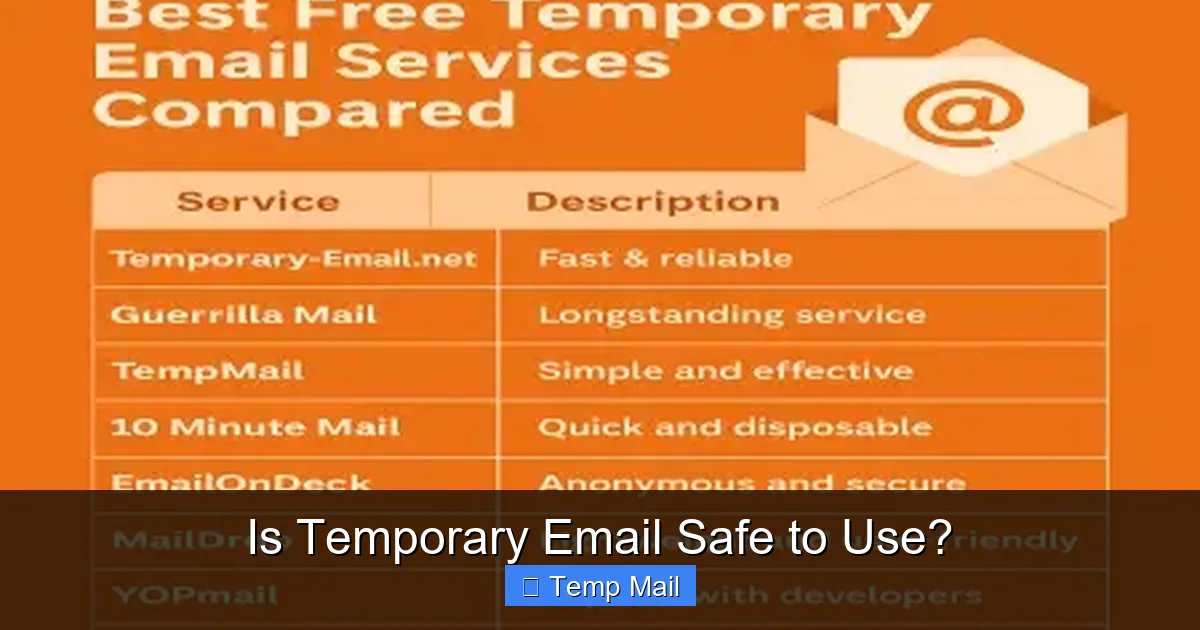
- Are widely referenced in tech forums (e.g., Temp-Mail.org, 10MinuteMail.com, Maildrop.cc). Avoid unknown sites with pop-up ads everywhere.
Remember, “reputable” in this context means “less likely to be a blatant scam,” not “secure and private.”
Rule 3: Combine with a VPN for Basic Anonymity
If you are concerned about your IP address being linked to the temp mail activity (which the provider can see), use a reputable VPN service before visiting the temp mail site. This masks your real IP from the provider, adding a small layer of anonymity. It does nothing for the email content’s security, but it separates your network identity from the disposable address.
Rule 4: Never Enter Sensitive Information Anywhere
Never, under any circumstances, use a temporary email to receive:
- Password reset links for important accounts.
- One-time passwords (OTPs) for 2FA.
- Credit card authorization codes.
- Medical test results or legal documents.
- Any personally identifiable information (PII) you wouldn’t want a stranger to see.
Assume every email in that inbox is public.
Rule 5: Be Aware of the “Session” Model
Understand your chosen provider’s model. Some keep the inbox alive as long as your browser tab is open. If you accidentally close it, the inbox and address are gone. Others have a fixed timer from creation. Know the rules so you don’t lose an expected email prematurely.
Conclusion: A Tool of Context, Not a Universal Solution
The question “Is temporary email safe?” has only one correct answer: It depends entirely on what you’re using it for. As a tool for its intended purpose—a short-lived, anonymous channel for low-value, non-sensitive communications—it is perfectly safe and highly effective. It performs its function of keeping your primary inbox pristine with aplomb. The danger arises when we misuse it, lulled by its convenience into applying it to domains where its fundamental flaws—lack of encryption, address recycling, no recovery—become catastrophic weaknesses.
Think of a temporary email like a public library computer. You can use it to quickly look up a fact, but you wouldn’t log into your bank account or write a confidential legal document on it. The safety profile is identical. The library computer (and the temp mail service) is a shared, transient resource with inherent privacy and security limitations. Your judgment in choosing when to use that resource is the ultimate determinant of your safety. Respect the disposability, understand the risks, and use it with clear intention. For everything else, a properly secured, permanent email address—ideally with two-factor authentication and from a provider with a strong privacy stance—remains the only safe choice.
Frequently Asked Questions
Is using a temporary email address illegal?
No, using a temporary email service is not illegal. The service itself is a legitimate tool for privacy. However, using it for illegal activities like fraud, harassment, or to circumvent a legal ban is illegal, regardless of the email type used.
Do websites and apps block temporary email addresses?
Yes, many major platforms (like Google, Facebook, Twitter, and most financial services) actively block known temporary email domains during sign-up. They maintain updated blocklists to prevent spam and fake account creation. If your temp address is blocked, you must use a real, permanent email.
Are temporary emails encrypted? Can anyone read my emails?
Almost all free temporary email services do not encrypt the email content stored on their servers. Emails are typically stored in plain text. This means the service provider can read them, and if their servers are compromised, hackers can read them too. You should assume any email sent to a temp address is publicly readable.
What are the most reputable temporary email services?
While “reputable” is relative, services with long-standing histories and clear interfaces include Temp-Mail.org, 10MinuteMail.com, and Maildrop.cc. Always review their privacy policy. Avoid services that are ad-heavy, require disabling security tools, or have vague data practices.
Can I use a temporary email for social media or gaming accounts?
No, this is a very bad idea. Social media and gaming platforms almost always prohibit disposable emails in their ToS. Your account will likely be flagged and banned. More importantly, you will lose access permanently if you need to recover your password, as the reset email goes to an expired address.
What happens to my temporary email after it expires?
The email address and all its contents are permanently deleted from the service’s server. The address is then recycled and assigned to a new, random user. Any future emails sent to that address will be received by that new user, not you. There is no way to recover the address or its emails after expiration.
Leave a Reply