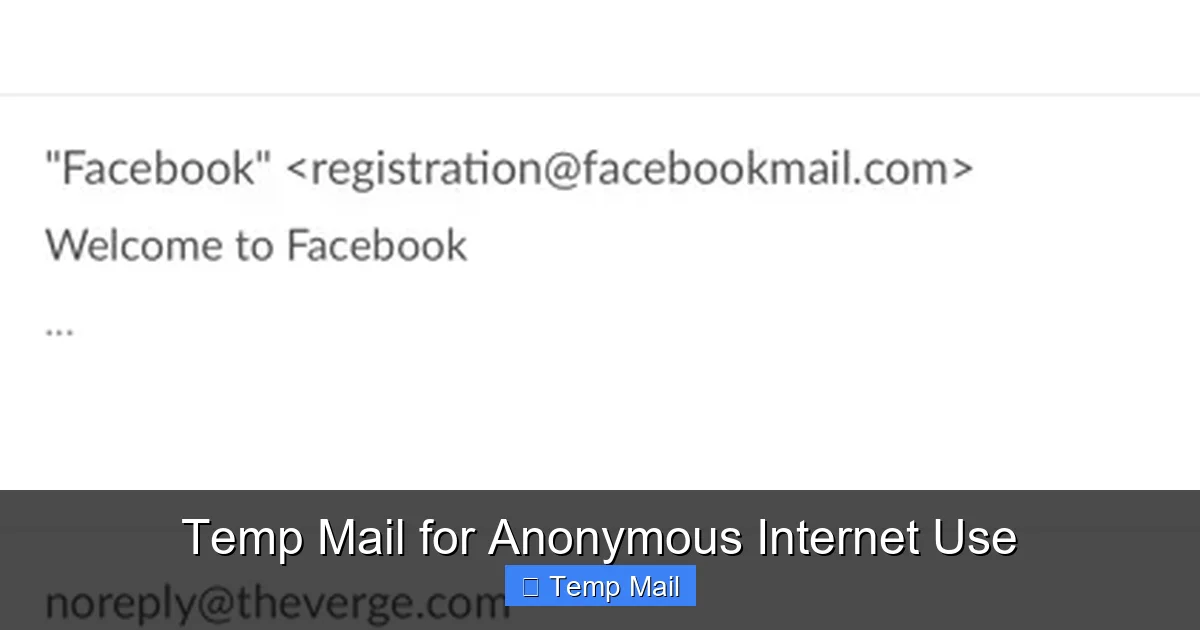
Temp mail services provide disposable, anonymous email addresses that shield your real identity online. They are perfect for signing up to websites, forums, or trials without risking spam or data breaches to your primary inbox. By using a temporary address that self-destructs, you maintain privacy and control over your digital footprint, making it an essential tool for cautious internet users.
Key Takeaways
- Core Purpose: Temp mail creates short-lived, anonymous email addresses to protect your primary identity and inbox from spam, tracking, and data breaches.
- How It Works: You generate a random address on a provider’s site, use it for a specific purpose, and the address (and all its emails) auto-deletes after a set time or upon inbox closure.
- Primary Benefit – Spam Prevention: It acts as a physical “burner phone” for the internet, containing all unwanted promotional emails and potential data leaks to a dead-end address.
- Not for Critical Accounts: Never use temp mail for banking, primary social media, or any account where password recovery and long-term access are absolutely essential.
- Anonymity vs. Security: While excellent for anonymity from marketers, temp mail is not encrypted secure messaging; sensitive data should never be sent to or from a disposable address.
- Legal and Ethical Use: Using temp mail is legal for privacy protection. It becomes problematic only if used for fraud, harassment, or to circumvent legitimate website bans.
- Smart Practice: Use a dedicated, reputable temp mail provider and develop a personal rule: “If it’s important, it doesn’t get a temp address.”
📑 Table of Contents
- What Exactly is Temp Mail? The Digital Burner Phone
- The Driving Force: Why People Seek Anonymous Email
- How Temp Mail Actually Works: A Step-by-Step Breakdown
- The Critical Limitations and Risks You Must Know
- Legal and Ethical Boundaries: Staying on the Right Side
- Best Practices: How to Use Temp Mail Wisely and Effectively
- The Future of Disposable Communication
- Conclusion: Reclaiming Your Digital Peace
What Exactly is Temp Mail? The Digital Burner Phone
Imagine you need to give a phone number to a store clerk for a one-time receipt, but you don’t want them having your real cell number forever. So, you hand over a number from a cheap, prepaid “burner” phone you’ll toss after the call. Temp mail is the email equivalent of that burner phone. It’s a service that provides you with a temporary, disposable email address—completely separate from your personal or work accounts—that exists for a short period, usually minutes or hours, before self-destructing along with all its contents.
This concept isn’t about hiding illicit activity; it’s about reclaiming agency. Every day, we’re asked to “create an account” or “subscribe for a discount” to access content, download a file, or try a software trial. Each of those forms is a potential gateway for spam, data harvesting, and a permanent link between your primary email and a website you may never visit again. Temp mail breaks that link. It gives you a shield. You get the access you need, and the website gets an email address that leads to a black hole, protecting your real identity and your long-term inbox peace.
The Anatomy of a Temp Mail Address
When you visit a temp mail website like Temp-Mail.org, 10MinuteMail.com, or Guerrilla Mail, you are instantly assigned a random email address. It typically looks something like xyz7f3b2@domain.com. You don’t create a password. There’s no login. You simply copy that address and paste it wherever required. The provider’s website then shows you an inbox interface for that specific address. Any email sent to that address appears in that browser tab in real-time.
Key characteristics of this address:
- No Account Creation: No username, no password, no personal details required.
- Randomly Generated: The address is algorithmically created, not tied to you.
- Ephemeral Lifespan: The clock starts ticking immediately. Some last 10 minutes, others 1 hour, some 24 hours. After that, the address and all emails vanish into the digital ether.
- Shared Inboxes (Usually): Many free services use the same domain for thousands of users. While you only see emails sent to *your* random string, the domain is public. This is why using a unique, randomized address is crucial.
The Driving Force: Why People Seek Anonymous Email
The motivation for using temp mail is almost universally rooted in a desire for privacy and control. It’s a direct response to the modern web’s “email-for-access” economy. Let’s break down the core reasons.
Visual guide about Temp Mail for Anonymous Internet Use
Image source: is1-ssl.mzstatic.com
Combatting the Spam Tsunami
This is the number one, most practical reason. You sign up for a “free ebook” from a marketing site. Unbeknownst to you, that action adds your email to a dozen mailing lists. Within days, your primary inbox is flooded with promotions, newsletters you never read, and “special offers.” Using a temp mail address for this ebook download contains the spam. It goes to an address that will expire before the first marketing email even arrives. Your real inbox remains pristine. It’s a preemptive spam filter with a 100% success rate for those disposable sign-ups.
Shielding Your Identity from Data Brokers and Trackers
When you use your real email to sign up for a forum, a game, or a survey, you are creating a data point. That website now has a verified, working email address linked to your activity on their platform. They may sell this “verified user” data to advertisers. Data brokers aggregate these points to build profiles about you. A temp mail address is a dead-end data point. It provides no long-term value to a data broker because it cannot be used to reliably contact or profile a real person over time. It anonymizes you at the point of entry.
Bypassing Regional Restrictions and Basic Blocks
Some websites or content platforms restrict access based on geography or require an account to view content. A temp mail can help you create a minimal account to bypass that initial barrier. It’s also a tool for accessing trial software or services that require an email, allowing you to evaluate them without committing your primary identity. This is about frictionless access, not malicious circumvention.
Testing and Development
For software developers, QA testers, and security researchers, temp mail is invaluable. They can test email verification flows, sign-up processes, or newsletter deliverability without polluting real inboxes or risking company domains. It’s a clean, disposable testing environment.
How Temp Mail Actually Works: A Step-by-Step Breakdown
Understanding the mechanics removes the mystery and helps you use the tool more effectively. The process is intentionally simple.
Visual guide about Temp Mail for Anonymous Internet Use
Image source: cdn.projects.co.id
Step 1: Visit the Provider and Get Your Address
You navigate to a temp mail service website. Upon loading, the backend system instantly generates a random username and pairs it with the service’s domain (e.g., @tempmail.demo). This combination is your temporary email address. It’s displayed prominently on the page. No action, no click, no information from you is required.
Step 2: Use the Address Where Needed
You copy the provided address (usually with one click) and paste it into the “email” field on the website you’re accessing. You then proceed to sign up, request a download link, or verify a phone number as required by that site. The website sends a confirmation email or a link to your *temporary* address.
Step 3: Receive and View the Email
Within seconds, that email appears in the inbox interface on the temp mail provider’s site. You refresh the page (or it auto-refreshes), and the email is there. You can open it, click links, or copy verification codes. The provider acts as a passive middleman, simply routing the email from the sender’s server to your temporary inbox view.
Step 4: The Inevitable Expiration
This is the critical step. A countdown timer is almost always visible. Once the time limit (e.g., 10 minutes, 1 hour) expires, the entire system purges that specific email address and all its associated data from their servers. The address becomes invalid. Any future emails sent to it bounce. The digital trail is erased. In some cases, the inbox may also clear if you close the browser tab before expiration, depending on the service’s model.
The Critical Limitations and Risks You Must Know
Temp mail is a powerful tool, but it is not a magic bullet for all privacy concerns. Using it without understanding its limitations can lead to real problems.
It’s Not for Account Recovery or Important Services
This cannot be stressed enough. If you use a temp mail to sign up for Facebook, your bank, a cloud storage service, or your main email provider, you will lose access forever the moment the address expires. You cannot reset a password you cannot receive. You will be permanently locked out. These services require a permanent, accessible email for account integrity and security. Temp mail is for disposable interactions only.
Security and Encryption Are Not Guaranteed
Most free temp mail services do not offer end-to-end encryption. The emails are stored in plain text on their servers during their short lifespan. While the risk is low due to the brief existence, you should never send sensitive personal information—passwords, financial data, Social Security numbers, confidential documents—via a temp mail address. Assume anything sent through it could be read by the provider during its active window. Its anonymity protects you from the *recipient*, not necessarily from the *service*.
Reliability and Delivery Issues
Some websites and email systems actively blacklist known temp mail domains to prevent abuse and fake account creation. You might find that a confirmation email simply never arrives because the sender’s server rejected the disposable domain. This is a common frustration. In these cases, you have no choice but to use a real email or try a different, less-blacklisted temp mail provider.
No Long-Term Archival or Search
Once the inbox expires, it’s gone. You cannot search for an old verification code from a week ago because it doesn’t exist. You must use the email immediately upon receipt. This makes it unsuitable for any communication that needs to be referenced later.
Legal and Ethical Boundaries: Staying on the Right Side
The legality of temp mail is clear in most jurisdictions: the tool itself is perfectly legal. Privacy is a fundamental right. However, the use of the tool determines its legality.
When Use is Legitimate and Ethical
- Protecting your primary email from spam when downloading a whitepaper.
- Signing up for a one-time forum discussion to ask a question.
- Testing a website’s sign-up flow as a developer.
- Accessing a paywalled article that requires a free account.
- Any scenario where you are not misrepresenting your identity for fraudulent gain.
When Use Crosses the Line
Using temp mail becomes illegal or a violation of Terms of Service when it is employed for:
- Fraud: Creating fake accounts to manipulate reviews, run scams, or abuse “new user” promotions.
- Harassment or Threats: Sending abusive or threatening messages while hiding behind anonymity.
- Circumventing Bans: If you are permanently banned from a service for violating rules, creating a new account with a temp mail to evade that ban is typically a direct breach of their Terms of Service.
- Illegal Transactions: Purchasing illegal goods or services.
Remember, while the temp mail address is anonymous to the website you’re signing up for, the temp mail provider itself may keep logs (IP addresses, timestamps) for a period, which could be subpoenaed in a criminal investigation. The anonymity is against the *website*, not against all possible legal discovery.
Best Practices: How to Use Temp Mail Wisely and Effectively
To integrate temp mail into your digital hygiene routine safely, follow these practical guidelines.
1. Establish a Clear Personal Rule
Adopt a simple, firm mental rule: “If the account or service is important for long-term use, identity, or recovery, it gets my permanent email. Everything else gets temp mail.” Your bank, primary email, main social media, cloud storage, and password manager are permanent. The cooking forum, the discount newsletter, the free trial of a graphic design tool you’re trying—these are disposable. This binary rule removes decision fatigue.
2. Choose a Reputable Provider
Not all temp mail services are equal. Look for providers that:
- Clearly state their data retention and deletion policies.
- Have a straightforward, ad-supported (or premium) model without hidden malware.
- Offer a domain that isn’t universally blacklisted (sometimes a less common domain works better).
- Allow you to manually “refresh” or extend the inbox time if needed.
- Popular, long-standing options like Temp-Mail.org, 10MinuteMail.com, and Guerrilla Mail have established trust, but always check their current privacy policy.
3. Use It and Forget It
Do not become attached to a temp mail address. Once you’ve received the verification email or the download link, you can close the tab. Do not bookmark it. Do not try to go back later. The value is in its impermanence. If you need to receive something more substantial, use your permanent email from the start.
4. Combine with Other Privacy Tools
Temp mail is one layer. For maximum anonymity on a sensitive task, consider using it in conjunction with:
- A reputable VPN or Tor browser to mask your IP address from the temp mail provider and the website you’re visiting.
- A privacy-focused browser in incognito/private mode to avoid cookie tracking from the temp mail site itself.
- This creates a more robust anonymity chain: your real IP is hidden, your real email is not used, and tracking cookies are minimized.
The Future of Disposable Communication
The demand for temp mail is a symptom of a larger issue: the broken relationship between users and the ad-driven internet. As data privacy regulations like GDPR and CCPA give users more rights, and as awareness of data harvesting grows, tools that offer “minimal viable identity” will become more mainstream. We may see:
- Integration with Password Managers: Services like Bitwarden or 1Password could include built-in, secure alias generation for emails (similar to Apple’s “Hide My Email” feature).
- More Sophisticated Aliasing: Services like SimpleLogin or AnonAddy (which are more advanced than basic temp mail) may become standard, allowing you to create unique, forwardable aliases that can be disabled at any time, blending the convenience of a permanent address with the control of disposability.
- Increased Blacklisting: As websites fight fake accounts, they will get better at blocking disposable domains, potentially creating a cat-and-mouse game that favors more sophisticated, less obvious aliasing services over simple temp mail.
The core principle will remain: your email address is a key to your identity. Guard it fiercely. Use disposable tools for the noisy, transactional parts of the web, and reserve your permanent address for the people and services you trust.
Conclusion: Reclaiming Your Digital Peace
Temp mail is not about being secretive; it’s about being selective. It’s a simple, powerful tool in the privacy-conscious user’s toolkit that directly counters the relentless data-collection economy of the web. By providing a sacrificial email address for the countless low-stakes interactions we have online daily, it prevents your primary identity from being endlessly traded, sold, and targeted. It contains spam to a dead-end, shields your identity from trackers, and gives you back a sense of control.
However, its power comes with clear boundaries. Its strength—impermanence—is also its greatest weakness. It is useless for anything requiring longevity, recovery, or trust. The key is mindful application. Use it wisely for what it’s designed for: the disposable, the promotional, the one-time-access points of the internet. For everything that matters—your finances, your core social connections, your critical accounts—cling to your permanent, secure email. In doing so, you build a smarter, more resilient digital life, one temporary address at a time.
Frequently Asked Questions
Is using temp mail legal?
Yes, using temp mail services is completely legal in most countries. It is a legitimate tool for protecting your privacy. It only becomes illegal if you use it specifically to commit fraud, harassment, or other criminal activities.
Can websites detect that I’m using a temp mail address?
Yes, many websites can and do detect temp mail domains. They often maintain lists of known disposable email providers and will block sign-ups from those domains. This is why you might sometimes find a confirmation email never arrives.
Is temp mail secure for sending private information?
No, it is not secure for sensitive data. Most temp mail services do not use end-to-end encryption. Emails are stored in plain text on their servers during the inbox’s short lifespan. You should never send passwords, financial details, or confidential documents via a disposable address.
What happens to my emails after the temp address expires?
They are permanently and irreversibly deleted from the temp mail provider’s servers. The email address is then recycled and given to a new user. Any future emails sent to that expired address will bounce.
Can I extend the life of my temp mail inbox?
Some providers offer a “refresh” button that adds more time (e.g., another 10 minutes) to the countdown timer. However, this is not unlimited and varies by service. The core design is for short-term use.
Should I use temp mail for social media or gaming accounts?
No. You should always use your permanent, accessible email for any account where you might need password recovery, long-term access, or where the account represents your identity (like Facebook, Instagram, Steam, or Xbox). Using temp mail for these will lead to a permanent lockout.
Leave a Reply